Creating my logo
And learning about hyperbolic space in the process.
I tend to use abstract profile pictures rather than a straightforward headshot.
One reason is that I prefer to have an interesting symbol rather than just my regular ol face, and I believe it’s more recognizable for building an online presence. The other is that if I’m being judged as a developer or in any professional setting, I’d rather the attention go to my skills, projects, and experience. So I prefer a symbol that reflects some of my sensibilities.
For the longest time that role was filled by the cover of the Discipline album by King Crimson, which I used on GitHub and LinkedIn.

I’m not the biggest King Crimson fan, but I’ve loved this album since I first heard it in high school. The symbol on the cover is a Celtic Knot, which I find beautiful and inspiring. It’s also circular, so it fits nicely into profile picture frames, which is the other requirement I have for a personal “logo”.
But this symbol isn’t mine, and it doesn’t reflect much about me beyond a single musical preference and maybe some aesthetic sensibilities. So I set out to design my own.
Even though my research into math-specific topics has waned since my time in high school and college, I still consider myself a math-loving nerd. Math can produce patterns far more beautiful than anything I could come up with by hand and creativity alone, so I built the design around it.
I looked at a few concepts that produce interesting circular visualizations, like epicycloids and polar roses.
But the one I found most interesting was the Poincaré Disk. Unlike the others, I wasn’t already familiar with the underlying math, since I’d never studied hyperbolic space before.
I won’t get into detail here since I don’t feel intimate enough with the concept yet to fully explain the math behind it, but the basic idea isn’t hard to grasp.
Most people know you can’t perfectly represent the Earth on a 2D map. You need some kind of projection, like the popular Mercator projection.
A more general way to put this is that you can’t map a spherical surface (e.g. the Earth) to a plane (e.g. 2D map).
The same is true of hyperbolic surfaces: they can’t be mapped cleanly to a plane either, so you need a projection.
This is what the Poincaré disk is: a projection of a hyperbolic surface.
Additional info on this topic:
- Hyperboloid and the Poincaré disk: Highly recommend watching this 40 second video to get a sense of how a hyperboloid gets mapped to the disk.
- Non-Euclidean Geometry Explained: More in-depth (10 min) explanation of what hyperbolic spaces are, and also explains and compares them with spherical spaces.
One fun thing about a hyperbolic surface is that it extends infinitely. That makes projecting it very different from projecting a sphere, which has a finite area. It also means the Poincaré Disk captures infinity within it. Partly due to this, Poincaré Disk visualizations tend to look like fractals, which makes them fun to look at. A common one maps a tiled plane onto the disk, which shows some other properties of hyperbolic space.
Here’s a popular example:
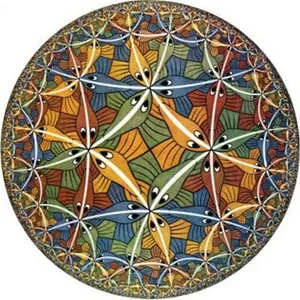
Circle Limit III (1959) by M.C. Escher. Via Wikipedia.
Circling back to my new profile picture, these tiled surfaces are too busy for my taste. But I was inspired by the first image on the Wikipedia page of the Poincaré disk. As of writing, it illustrates another fun property of hyperbolic space: given a line R and a point P not on it, at least two distinct lines pass through P without ever intersecting R.
This property is known as the “Parallel postulate”, but the version I just gave you is modified from the original, which applies to Euclidean (i.e. “normal”) space. In Euclidean space, if you have a line R and a point P not on it, there’s exactly one line through P that stays parallel to R and never intersects it.
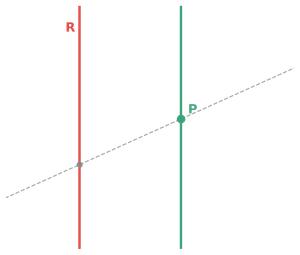
The parallel postulate in Euclidean space: through P, only the green line stays parallel to the red one. Any other line through P would eventually intersect with red.
It also sits in stark contrast to spherical spaces, where there are no parallel lines at all, it’s impossible to draw 2 lines that don’t intersect.
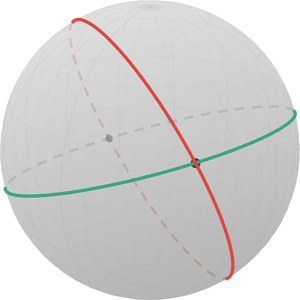
On a sphere, any two “straight lines” (great circles) meet at two antipodal points. The red one plays the role of R.
Anyways that was enough math, long story short I created a Python script that allowed me to design my final logo. Which I finally present, without further ado and in a bigger resolution than usual to be appreciated in all its glory:
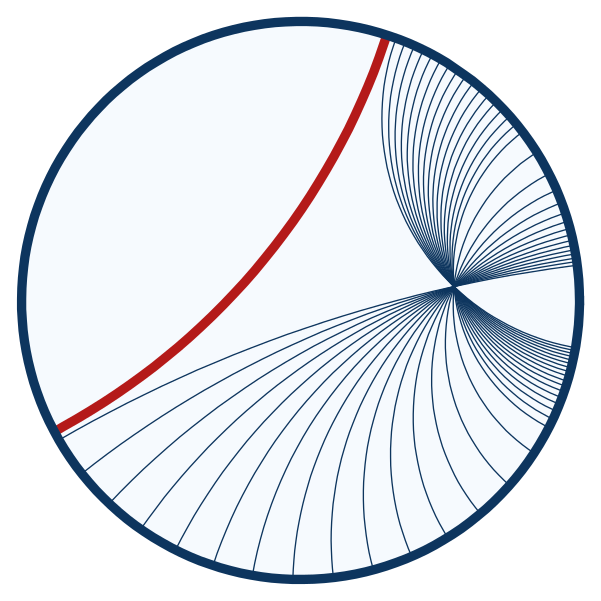
The hyperbolic parallel postulate in action: infinitely many lines pass through P without ever crossing the red one.
One final note: even though the lines on the disk look like curves, that’s only because it’s a projection. If you were a 2D being living on a hyperbolic surface, all of them would look perfectly straight and extend forever.
PS: To any mathematicians that read this, please be merciful.